



谭天与图像写作 TAN TIAN & IMAGE WRITING
IMAGE WRITING FROM A LINGUISTIC PERSPECTIVE 语言学视野下的图像写作
THE POLITICS OF SIGNS 符号的政治
FROM STORY TO NARRATIVE 从故事到叙事
HYPERTEXT 超文本
谭天与图像写作
2.语言学视野下的图像写作
“图像写作”的一个重要理论起点,来自索绪尔所建立的现代语言学以及他对于符号关系的理解。 索绪尔将语言符号区分为“能指”与“所指”。一个词的意义并不来自它与现实对象之间天然、固定的对应,而是在语言系统内部,通过符号与其他符号之间的差异和关系被建立起来。 这一观念改变了我们理解语言的方式,也为重新理解图像提供了一种可能。 在谭天的“图像写作”中,一个人物、一只动物、一棵树、一间房子、一条道路,都可以像语言中的词一样,被视为一个进入文本的视觉符号。 图像不再只是被描绘的对象,而成为“能指”。 与此同时,一个图像也并不拥有唯一而固定的“所指”。 一条鱼可以指向生命、欲望、自由、宗教、死亡或者某段私人记忆;一个房间可以意味着住所、安全、孤独、身体、边界或者囚禁。 因此,图像的意义并不是在它进入画面之前就已经被完全决定。 意义产生于符号之间的关系。 当多个图像进入同一个画面,它们开始像词语进入句子一样彼此作用。一个符号会限制、改变或重新解释另一个符号的意义,而新的符号加入,又会使原本建立的意义发生变化。 因此,构建一个画面,不再只是安排人物、物体、色彩与构图。 它更接近于建立一个语言学意义上的语境。 艺术家选择图像,如同写作者选择词语;组织图像之间的关系,如同组织句子与文本。 图像成为词。 图像之间产生关系。 画面最终成为可以被阅读的文本。 这正是“图像写作”的基础。
1.从再现到语言
古典绘画很长时间面对的一个核心问题,是如何再现我们所看到的世界。 人物、身体、风景与物体被描绘出来,图像与现实之间保持着某种对应关系。艺术家通过透视、明暗、色彩与造型,使二维平面产生对于现实世界的再现。 现代艺术改变了这种关系。 摄影的出现、现代主义的发展以及抽象艺术的产生,使绘画逐渐摆脱了再现现实的传统使命。图像可以被分解,形式可以独立,色彩、线条、平面与材料本身都可以成为艺术。 当现代主义关于形式与抽象的实验被不断推进之后,一个问题重新出现: 如果艺术家再次使用具象图像,我们为什么还要画一个“人”、一棵“树”、一座“房子”或者一条“鱼”? 重新使用具象,并不意味着重新回到古典艺术。 当代绘画中的具象图像不必再承担“模仿现实”的使命。 它可以成为语言。
3.符号的政治
4.从故事到叙事
但“写作”从来不仅仅意味着讲述一个故事。 进入现代文学之后,线性的故事结构早已被不断打破。时间可以错位,事件可以重复,叙述者可以变得不可靠,一个故事可以拥有彼此矛盾的版本,文本甚至可以开始讨论自身的结构。 因此,如果绘画是一种“图像写作”,它面对的问题也必然进一步从图像文本进入叙事结构。 一件绘画作品可以是一套图像文本。 而多件作品之间,又可以建立新的关系,形成更大的文本。 文本与文本继续发生作用,一个更加复杂的叙事结构由此产生。 《塔罗》就是这种方法的典型案例。 22件作品中的每一件,首先都是可以独立观看与阅读的“图像写作”作品。 但每一张又承接上一张,同时进入下一张。 人物、符号、事件、情绪与线索不断在作品之间迁移、重复和改变。 最终,22个彼此独立的图像文本首尾相接,构成一个环形叙事: 出发 → 成长 → 冲突 → 崩塌 → 碎裂 → 重组 → 回归 → 出发 当最后一张作品重新把观看者送回第一张时,第一张画本身并没有发生变化,但它的意义已经改变。 因为此前发生的一切,已经重新定义了我们观看它的方式。 终点重新解释起点。 起点又再次开启整个叙事。 到了这里,意义已经不再只存在于某一个图像内部。 它开始存在于图像与图像、文本与文本,以及观看顺序之间的关系之中。 这也使“图像写作”进入到阿兰·罗伯-格里耶的叙事实验以及罗兰·巴特关于文本、符号与阅读所打开的更复杂的叙事结构之中。
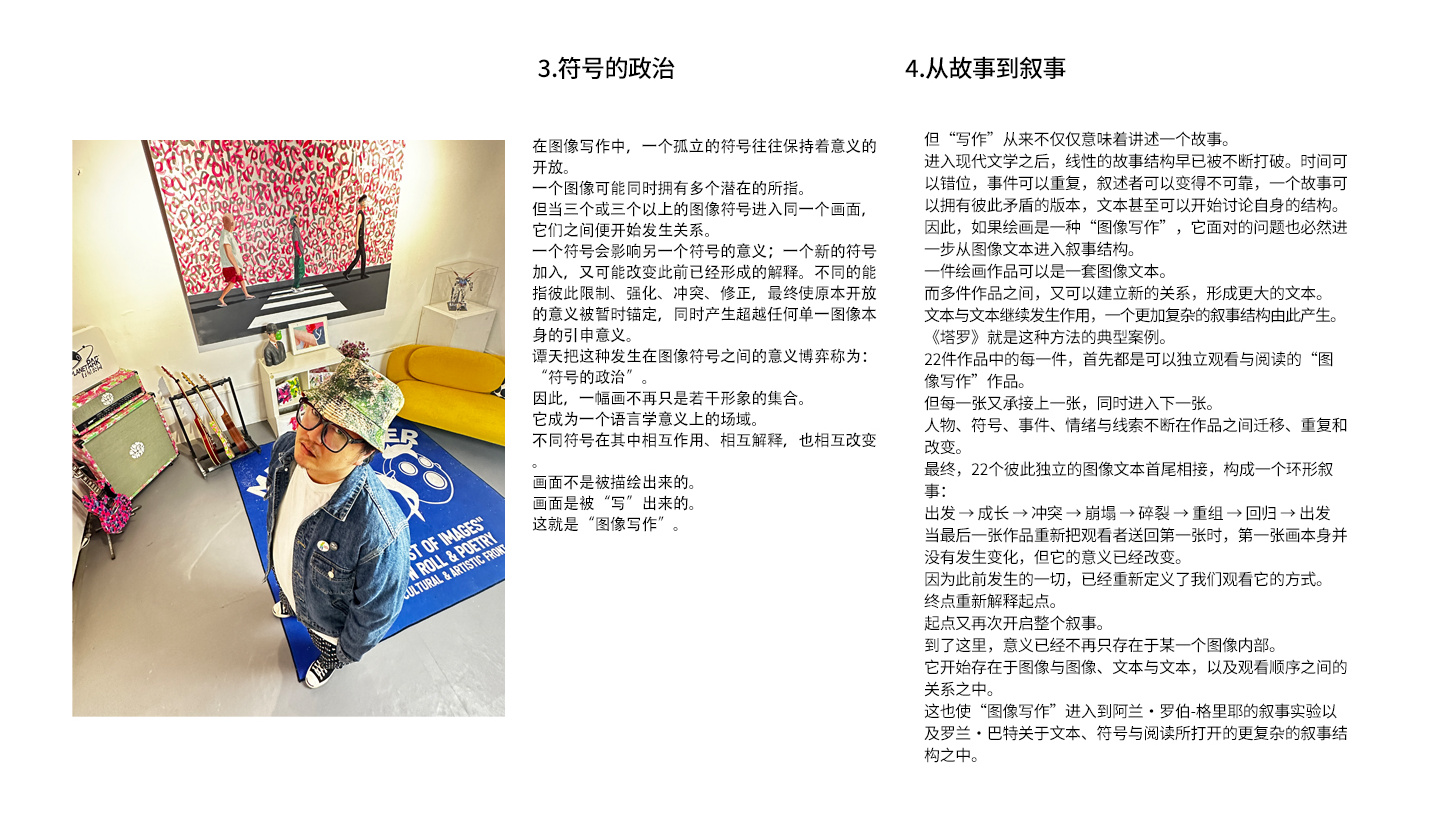
在图像写作中,一个孤立的符号往往保持着意义的开放。 一个图像可能同时拥有多个潜在的所指。 但当三个或三个以上的图像符号进入同一个画面,它们之间便开始发生关系。 一个符号会影响另一个符号的意义;一个新的符号加入,又可能改变此前已经形成的解释。不同的能指彼此限制、强化、冲突、修正,最终使原本开放的意义被暂时锚定,同时产生超越任何单一图像本身的引申意义。 谭天把这种发生在图像符号之间的意义博弈称为: “符号的政治”。 因此,一幅画不再只是若干形象的集合。 它成为一个语言学意义上的场域。 不同符号在其中相互作用、相互解释,也相互改变。 画面不是被描绘出来的。 画面是被“写”出来的。 这就是“图像写作”。
5.超文本
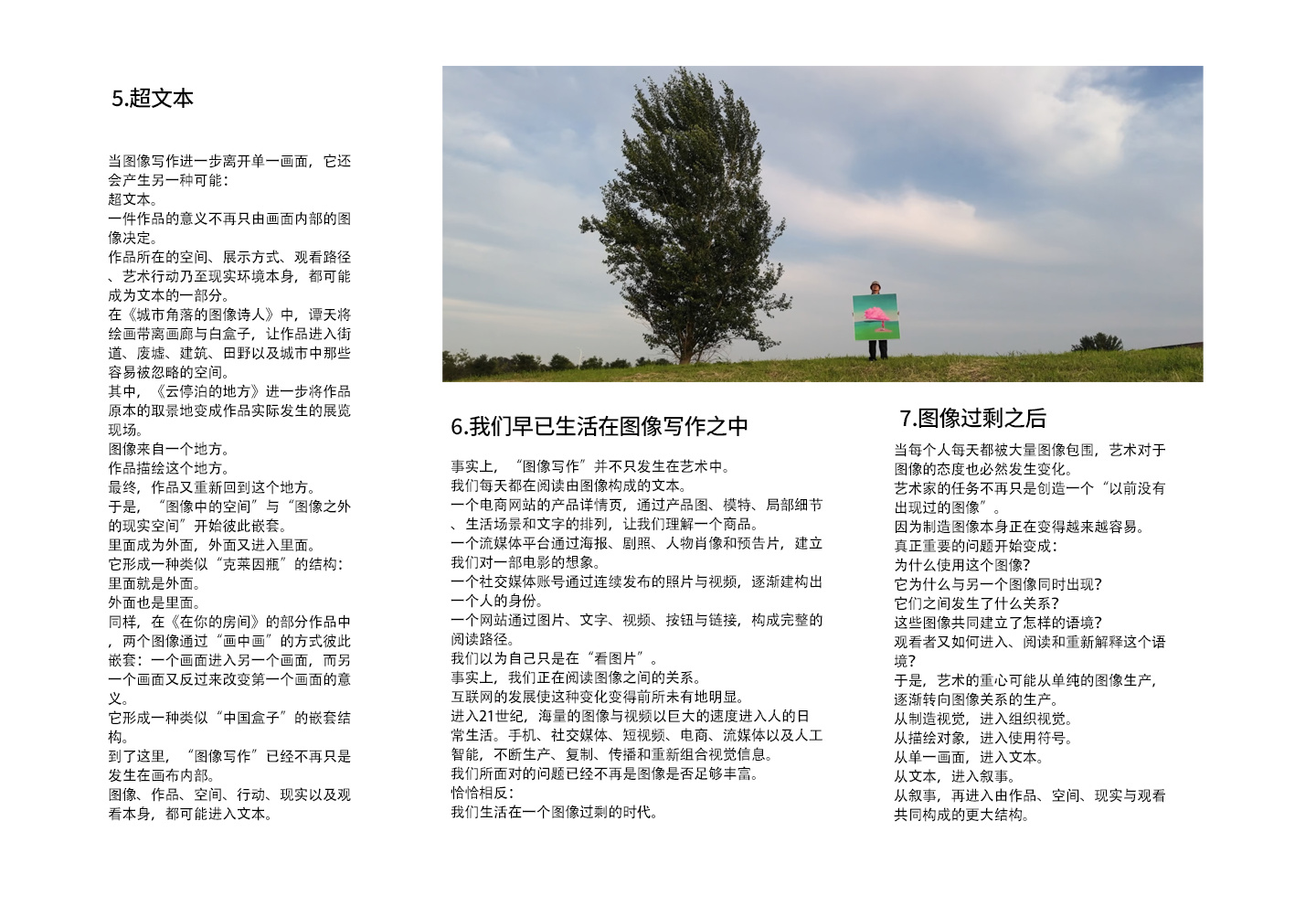
当图像写作进一步离开单一画面,它还会产生另一种可能: 超文本。 一件作品的意义不再只由画面内部的图像决定。 作品所在的空间、展示方式、观看路径、艺术行动乃至现实环境本身,都可能成为文本的一部分。 在《城市角落的图像诗人》中,谭天将绘画带离画廊与白盒子,让作品进入街道、废墟、建筑、田野以及城市中那些容易被忽略的空间。 其中,《云停泊的地方》进一步将作品原本的取景地变成作品实际发生的展览现场。 图像来自一个地方。 作品描绘这个地方。 最终,作品又重新回到这个地方。 于是,“图像中的空间”与“图像之外的现实空间”开始彼此嵌套。 里面成为外面,外面又进入里面。 它形成一种类似“克莱因瓶”的结构: 里面就是外面。 外面也是里面。 同样,在《在你的房间》的部分作品中,两个图像通过“画中画”的方式彼此嵌套:一个画面进入另一个画面,而另一个画面又反过来改变第一个画面的意义。 它形成一种类似“中国盒子”的嵌套结构。 到了这里,“图像写作”已经不再只是发生在画布内部。 图像、作品、空间、行动、现实以及观看本身,都可能进入文本。
7.图像过剩之后
6.我们早已生活在图像写作之中
当每个人每天都被大量图像包围,艺术对于图像的态度也必然发生变化。 艺术家的任务不再只是创造一个“以前没有出现过的图像”。 因为制造图像本身正在变得越来越容易。 真正重要的问题开始变成: 为什么使用这个图像? 它为什么与另一个图像同时出现? 它们之间发生了什么关系? 这些图像共同建立了怎样的语境? 观看者又如何进入、阅读和重新解释这个语境? 于是,艺术的重心可能从单纯的图像生产,逐渐转向图像关系的生产。 从制造视觉,进入组织视觉。 从描绘对象,进入使用符号。 从单一画面,进入文本。 从文本,进入叙事。 从叙事,再进入由作品、空间、现实与观看共同构成的更大结构。
事实上,“图像写作”并不只发生在艺术中。 我们每天都在阅读由图像构成的文本。 一个电商网站的产品详情页,通过产品图、模特、局部细节、生活场景和文字的排列,让我们理解一个商品。 一个流媒体平台通过海报、剧照、人物肖像和预告片,建立我们对一部电影的想象。 一个社交媒体账号通过连续发布的照片与视频,逐渐建构出一个人的身份。 一个网站通过图片、文字、视频、按钮与链接,构成完整的阅读路径。 我们以为自己只是在“看图片”。 事实上,我们正在阅读图像之间的关系。 互联网的发展使这种变化变得前所未有地明显。 进入21世纪,海量的图像与视频以巨大的速度进入人的日常生活。手机、社交媒体、短视频、电商、流媒体以及人工智能,不断生产、复制、传播和重新组合视觉信息。 我们所面对的问题已经不再是图像是否足够丰富。 恰恰相反: 我们生活在一个图像过剩的时代。
8.图像写作
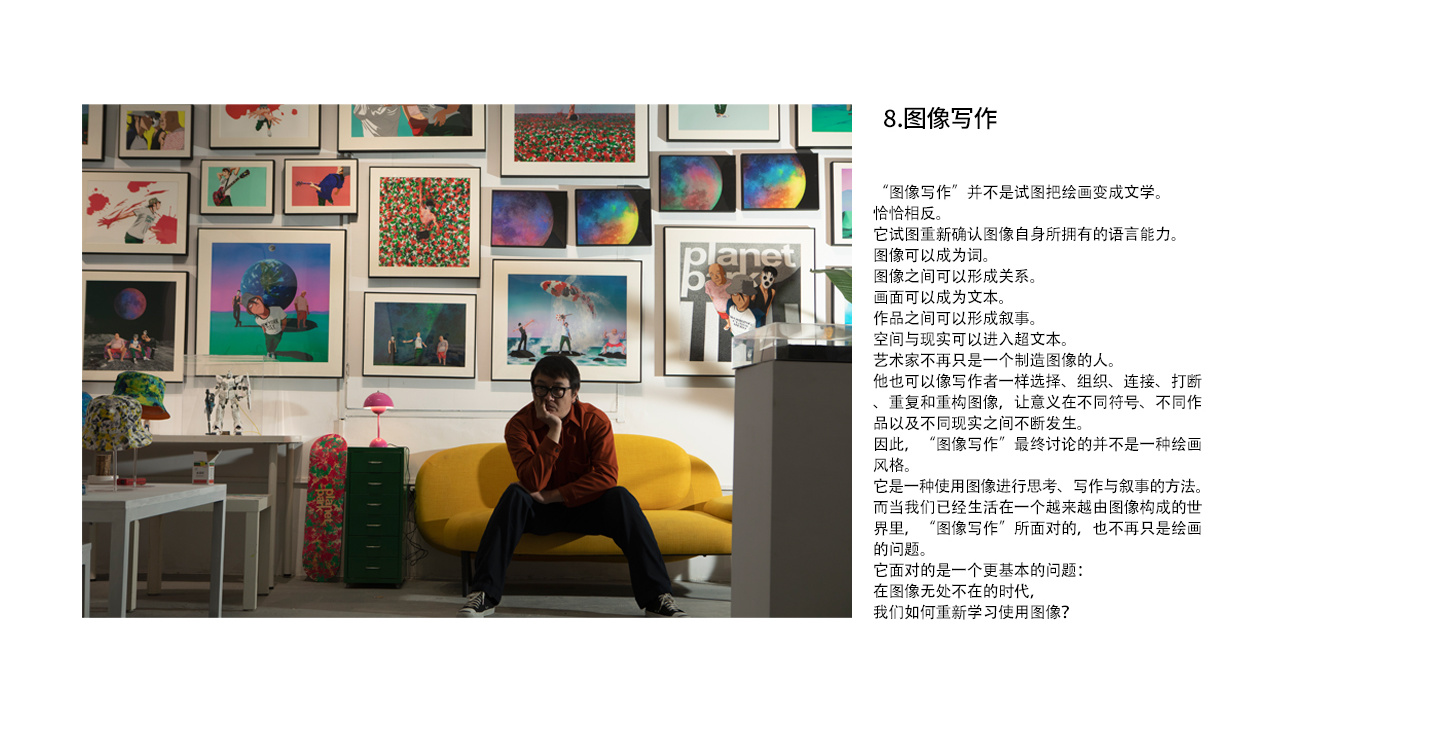
“图像写作”并不是试图把绘画变成文学。 恰恰相反。 它试图重新确认图像自身所拥有的语言能力。 图像可以成为词。 图像之间可以形成关系。 画面可以成为文本。 作品之间可以形成叙事。 空间与现实可以进入超文本。 艺术家不再只是一个制造图像的人。 他也可以像写作者一样选择、组织、连接、打断、重复和重构图像,让意义在不同符号、不同作品以及不同现实之间不断发生。 因此,“图像写作”最终讨论的并不是一种绘画风格。 它是一种使用图像进行思考、写作与叙事的方法。 而当我们已经生活在一个越来越由图像构成的世界里,“图像写作”所面对的,也不再只是绘画的问题。 它面对的是一个更基本的问题: 在图像无处不在的时代, 我们如何重新学习使用图像?
TAN TIAN & IMAGE WRITING
2.IMAGE WRITING FROM A LINGUISTIC PERSPECTIVE
1.FROM REPRESENTATION TO LANGUAGE
For a long period in the history of classical painting, one of its central concerns was how to represent the visible world. Figures, bodies, landscapes and objects were depicted through a visual relationship with reality. Through perspective, light and shadow, color and form, artists developed ways of creating representations of the physical world on a two-dimensional surface. Modern art fundamentally changed this relationship. With the emergence of photography, the development of modernism and the rise of abstraction, painting gradually moved away from its traditional responsibility to represent reality. Images could be fragmented; form could become autonomous; color, line, surface and material could themselves become the subject of art. After modernism had repeatedly pushed the possibilities of form and abstraction, a question emerged once again: If artists return to figurative imagery, why do we still paint a “person,” a “tree,” a “house,” or a “fish”? To return to the figurative does not mean returning to classical art. The figurative image in contemporary painting no longer needs to serve the purpose of imitating reality. It can become language.
An important theoretical starting point for “Image Writing” comes from modern linguistics established by Ferdinand de Saussure and his understanding of the relationships between signs. Saussure distinguished the linguistic sign into the signifier and the signified. The meaning of a word does not arise from a natural and fixed correspondence between the word and an object in reality. Rather, meaning is produced within a linguistic system through differences and relationships between signs. This idea fundamentally changed the way language could be understood. It also offers another way of thinking about images. In Tan Tian’s practice of Image Writing, a person, an animal, a tree, a room or a road can function like a word — as a visual sign entering a text. The image is no longer simply an object being depicted. It becomes a signifier. At the same time, an image does not possess a single fixed signified. A fish may suggest life, desire, freedom, religion, death, or a fragment of personal memory. A room may signify shelter, security, loneliness, the body, a boundary, or confinement. The meaning of an image, therefore, is not completely determined before it enters the composition. Meaning emerges through relationships between signs. When multiple images enter the same pictorial space, they begin to act upon one another much as words do when entering a sentence. One sign may limit, alter or reinterpret another, while the introduction of a new sign may shift a meaning that had already begun to form. Constructing an image, then, is no longer simply a matter of arranging figures, objects, colors and composition. It becomes closer to constructing a context in the linguistic sense. The artist selects images as a writer selects words, and organizes relationships between images as a writer constructs sentences and texts. Images become words. Relationships emerge between images. The picture becomes a text that can be read. This is the foundation of Image Writing.
3.THE POLITICS OF SIGNS
4.FROM STORY TO NARRATIVE
Within Image Writing, an isolated sign often remains open to multiple meanings. A single image may contain several possible signifieds. But when three or more visual signs enter the same pictorial space, relationships begin to form between them. One sign affects the meaning of another. The introduction of a new sign may alter an interpretation that has already begun to take shape. Different signifiers limit, reinforce, conflict with and modify one another. Through this process, otherwise open meanings become temporarily anchored, while further meanings emerge that cannot be reduced to any single image. Tan Tian calls this negotiation of meaning between visual signs: “The Politics of Signs.” A painting is therefore no longer simply a collection of images. It becomes a linguistic field. Signs interact, interpret and transform one another within it. The picture is not simply depicted. It is “written.” This is Image Writing.
Writing, however, has never meant simply telling a story. Modern literature repeatedly broke apart the conventions of linear narrative. Time can become displaced. Events can repeat. Narrators can become unreliable. A story can contain contradictory versions of itself, and a text can even begin to reflect upon its own structure. If painting can operate as Image Writing, then it must also move beyond the visual text toward the question of narrative structure. A single painting can function as one visual text. Multiple works can then establish relationships with one another, forming a larger text. As texts interact with other texts, more complex narrative structures begin to emerge. Tan Tian’s TAROT is one example of this approach. Each of its 22 works is an independent piece of Image Writing that can be viewed and read on its own. Yet each image also continues from the previous one and leads into the next. Characters, signs, events, emotions and clues migrate between the works, repeating, shifting and acquiring new meanings. Eventually, the 22 independent visual texts connect beginning and end to form a circular narrative: Departure → Growth → Conflict → Collapse → Fragmentation → Reconstruction → Return → Departure When the final work returns the viewer to the first, the first image itself has not changed — but its meaning has. Everything that has happened in between has transformed the way we now read it. The ending reinterprets the beginning. The beginning opens the narrative once again. At this point, meaning no longer exists solely within an individual image. It also exists in the relationships between images, between texts, and within the sequence through which they are read. Here, Image Writing begins to enter the more complex questions of narrative structure opened by the narrative experiments of Alain Robbe-Grillet and by Roland Barthes’ thinking on text, signs and reading.
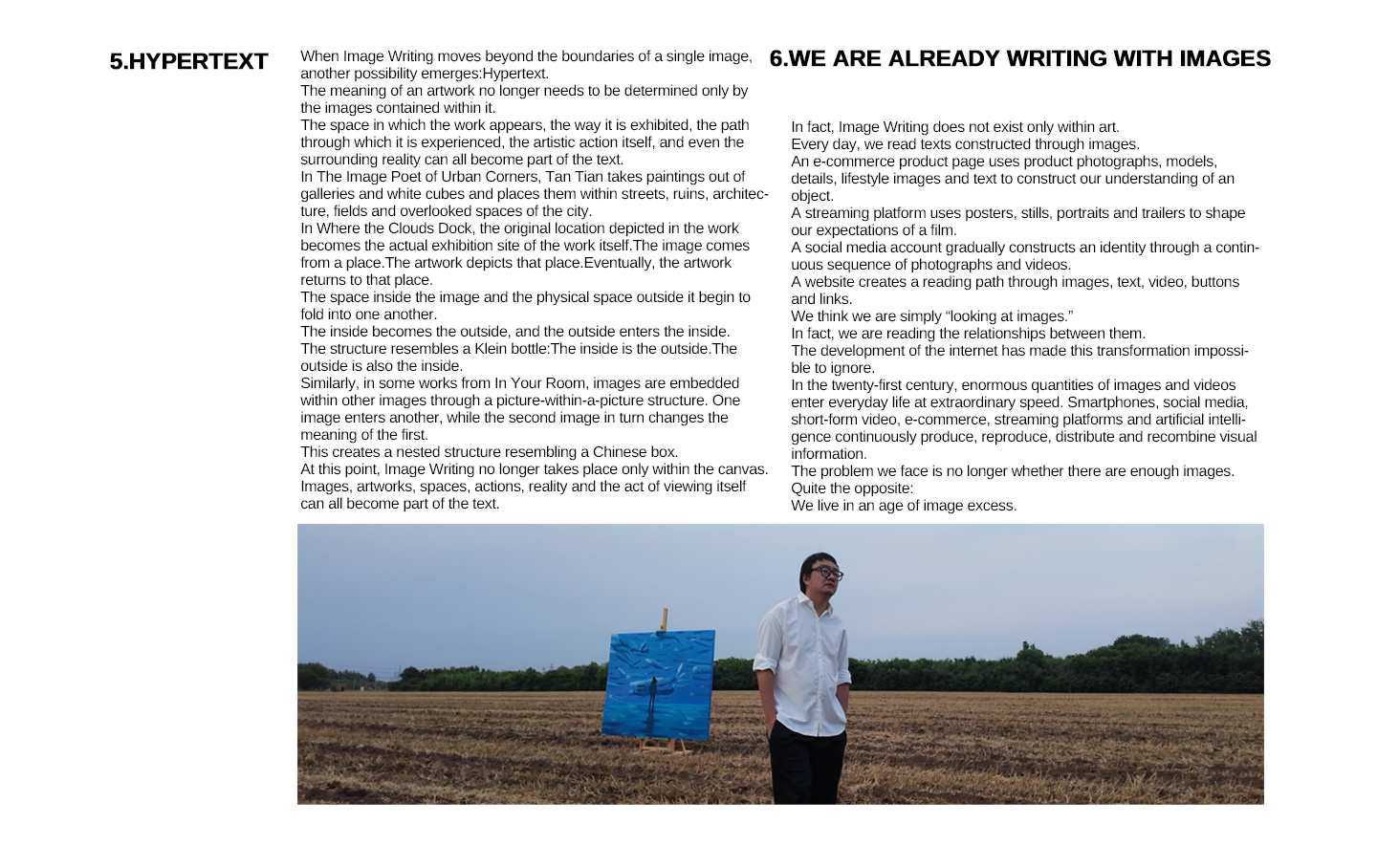
When Image Writing moves beyond the boundaries of a single image, another possibility emerges:Hypertext. The meaning of an artwork no longer needs to be determined only by the images contained within it. The space in which the work appears, the way it is exhibited, the path through which it is experienced, the artistic action itself, and even the surrounding reality can all become part of the text. In The Image Poet of Urban Corners, Tan Tian takes paintings out of galleries and white cubes and places them within streets, ruins, architecture, fields and overlooked spaces of the city. In Where the Clouds Dock, the original location depicted in the work becomes the actual exhibition site of the work itself.The image comes from a place.The artwork depicts that place.Eventually, the artwork returns to that place. The space inside the image and the physical space outside it begin to fold into one another. The inside becomes the outside, and the outside enters the inside. The structure resembles a Klein bottle:The inside is the outside.The outside is also the inside. Similarly, in some works from In Your Room, images are embedded within other images through a picture-within-a-picture structure. One image enters another, while the second image in turn changes the meaning of the first. This creates a nested structure resembling a Chinese box. At this point, Image Writing no longer takes place only within the canvas. Images, artworks, spaces, actions, reality and the act of viewing itself can all become part of the text.
6.WE ARE ALREADY WRITING WITH IMAGES
5.HYPERTEXT
In fact, Image Writing does not exist only within art. Every day, we read texts constructed through images. An e-commerce product page uses product photographs, models, details, lifestyle images and text to construct our understanding of an object. A streaming platform uses posters, stills, portraits and trailers to shape our expectations of a film. A social media account gradually constructs an identity through a continuous sequence of photographs and videos. A website creates a reading path through images, text, video, buttons and links. We think we are simply “looking at images.” In fact, we are reading the relationships between them. The development of the internet has made this transformation impossible to ignore. In the twenty-first century, enormous quantities of images and videos enter everyday life at extraordinary speed. Smartphones, social media, short-form video, e-commerce, streaming platforms and artificial intelligence continuously produce, reproduce, distribute and recombine visual information. The problem we face is no longer whether there are enough images. Quite the opposite: We live in an age of image excess.
7.AFTER THE IMAGE
8.IMAGE WRITING
Image Writing is not an attempt to turn painting into literature. Quite the opposite. It is an attempt to recognize the linguistic potential already present within images themselves. Images can become words. Relationships can be constructed between images. A picture can become a text. Works can form narratives with one another. Space and reality can enter the hypertext. The artist is no longer simply someone who produces images. Like a writer, the artist can select, organize, connect, interrupt, repeat and reconstruct images, allowing meaning to emerge continuously between different signs, different works and different realities. Image Writing, therefore, is ultimately not a style of painting. It is a method of thinking, writing and narrating through images. And as we increasingly inhabit a world constructed through images, Image Writing no longer addresses painting alone. It confronts a more fundamental question: In an age when images are everywhere, how do we learn to use images again?
When everyone is surrounded by vast quantities of images every day, art’s relationship with the image must inevitably change. The artist’s task can no longer be simply to produce an image that has “never been seen before.” The production of images itself is becoming increasingly easy. The more important questions become: Why use this image? Why does it appear alongside another image? What happens between them? What kind of context do these images construct together? How does the viewer enter, read and reinterpret that context? The focus of art may therefore begin to shift from the production of images toward the production of relationships between images. From producing the visual to organizing the visual. From depicting objects to using signs. From the single image to the text. From text to narrative. And from narrative toward larger structures constructed through artworks, spaces, reality and the act of viewing itself.
版权所有:行星文化(苏州)有限公司 苏ICP备2021005664号-1