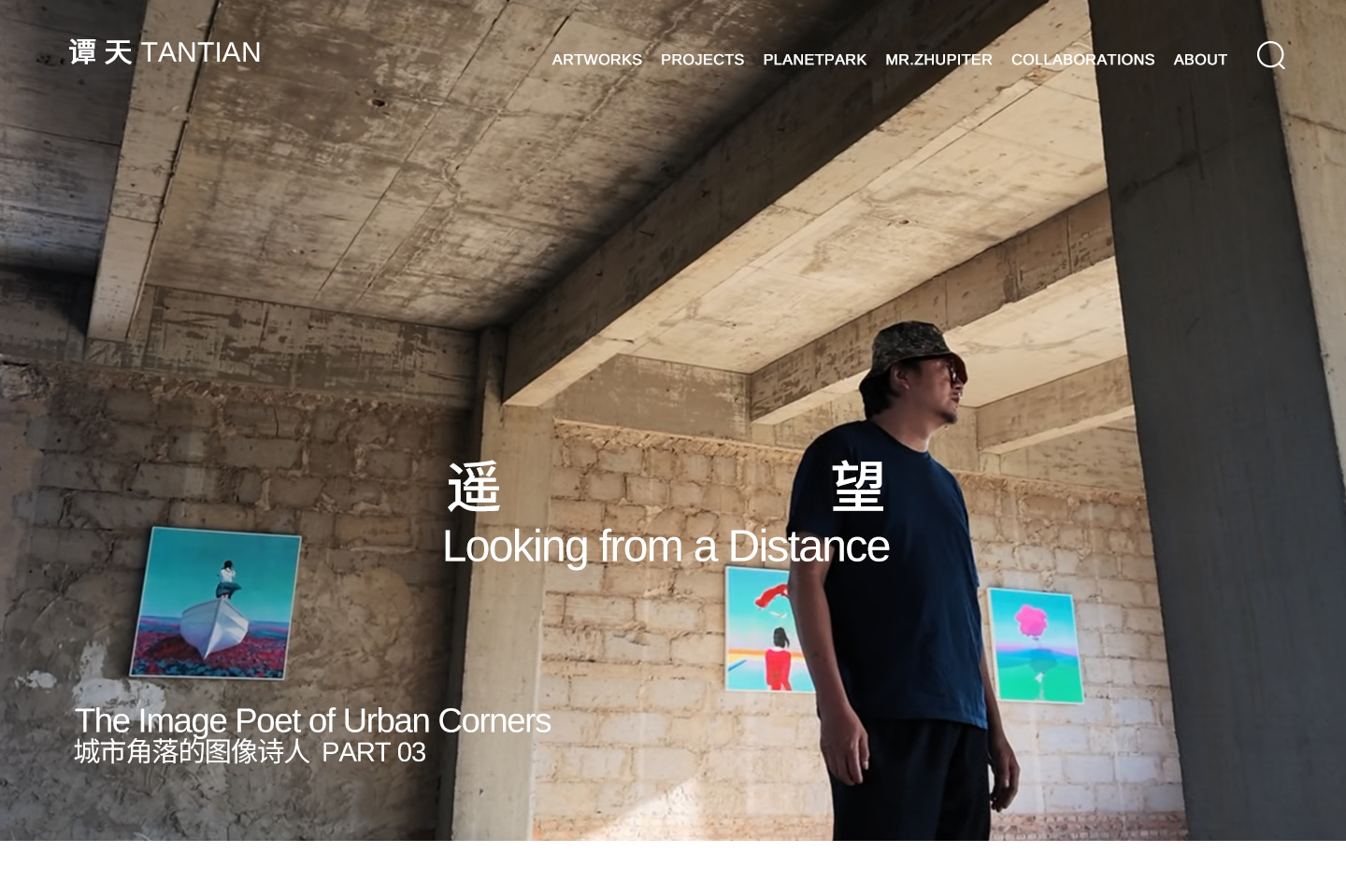


混凝土楼里的人,标题是遥望、Looking from a Distance。
遥 望
Looking from a Distance
The Image Poet of Urban Corners
城市角落的图像诗人 PART 03
01 世界上最长的一公里
北京到燕郊,燕潮大桥连接着潮白河两岸。
这一段路开车从西向东,不到两分钟,不到一公里,却是很多人用尽半生,都无法跨越的距离。
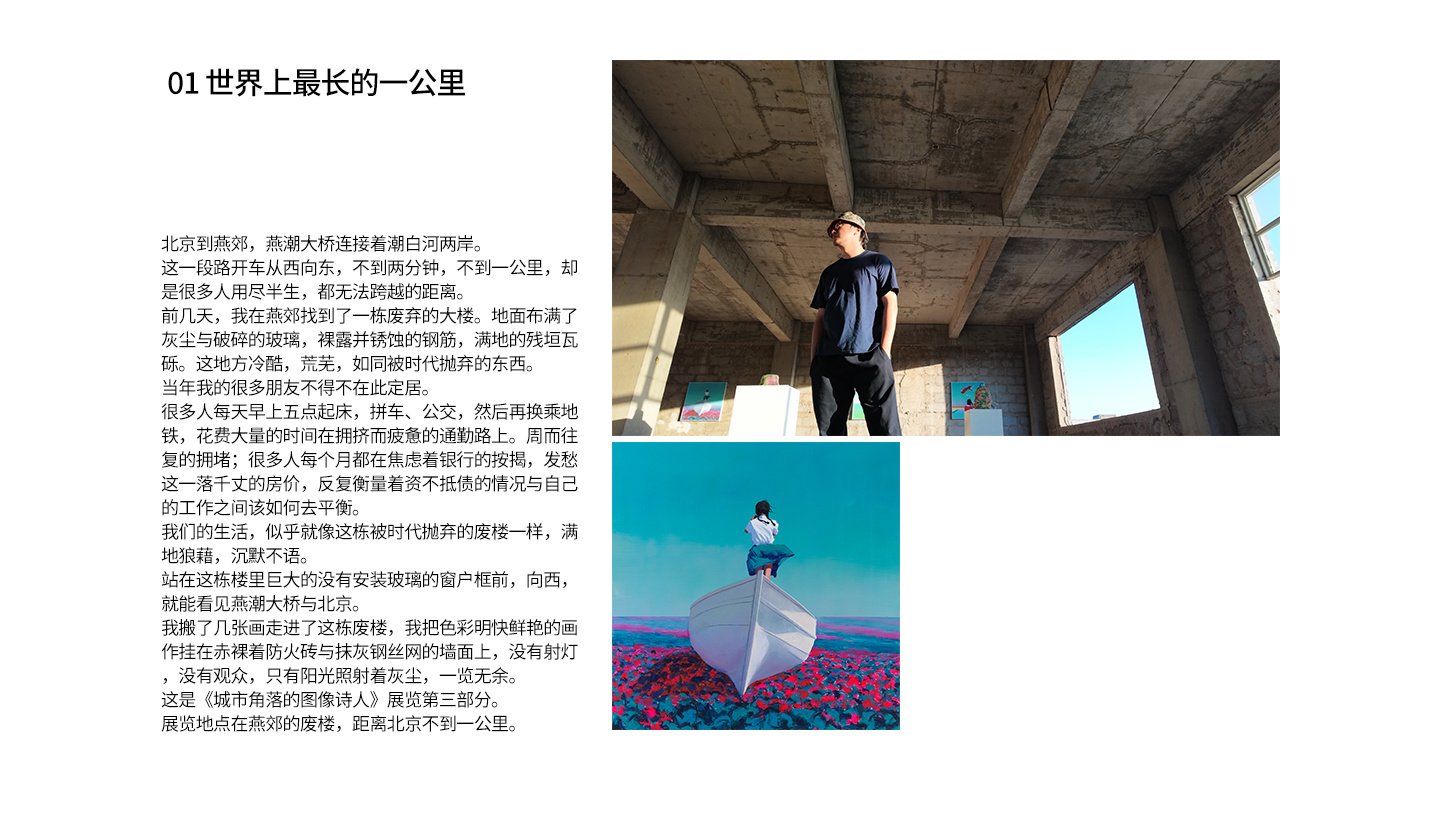
前几天,我在燕郊找到了一栋废弃的大楼。地面布满了灰尘与破碎的玻璃,裸露并锈蚀的钢筋,满地的残垣瓦砾。这地方冷酷,荒芜,如同被时代抛弃的东西。
当年我的很多朋友不得不在此定居。
很多人每天早上五点起床,拼车、公交,然后再换乘地铁,花费大量的时间在拥挤而疲惫的通勤路上。周而往复的拥堵;很多人每个月都在焦虑着银行的按揭,发愁这一落千丈的房价,反复衡量着资不抵债的情况与自己的工作之间该如何去平衡。
我们的生活,似乎就像这栋被时代抛弃的废楼一样,满地狼藉,沉默不语。
站在这栋楼里巨大的没有安装玻璃的窗户框前,向西,就能看见燕潮大桥与北京。
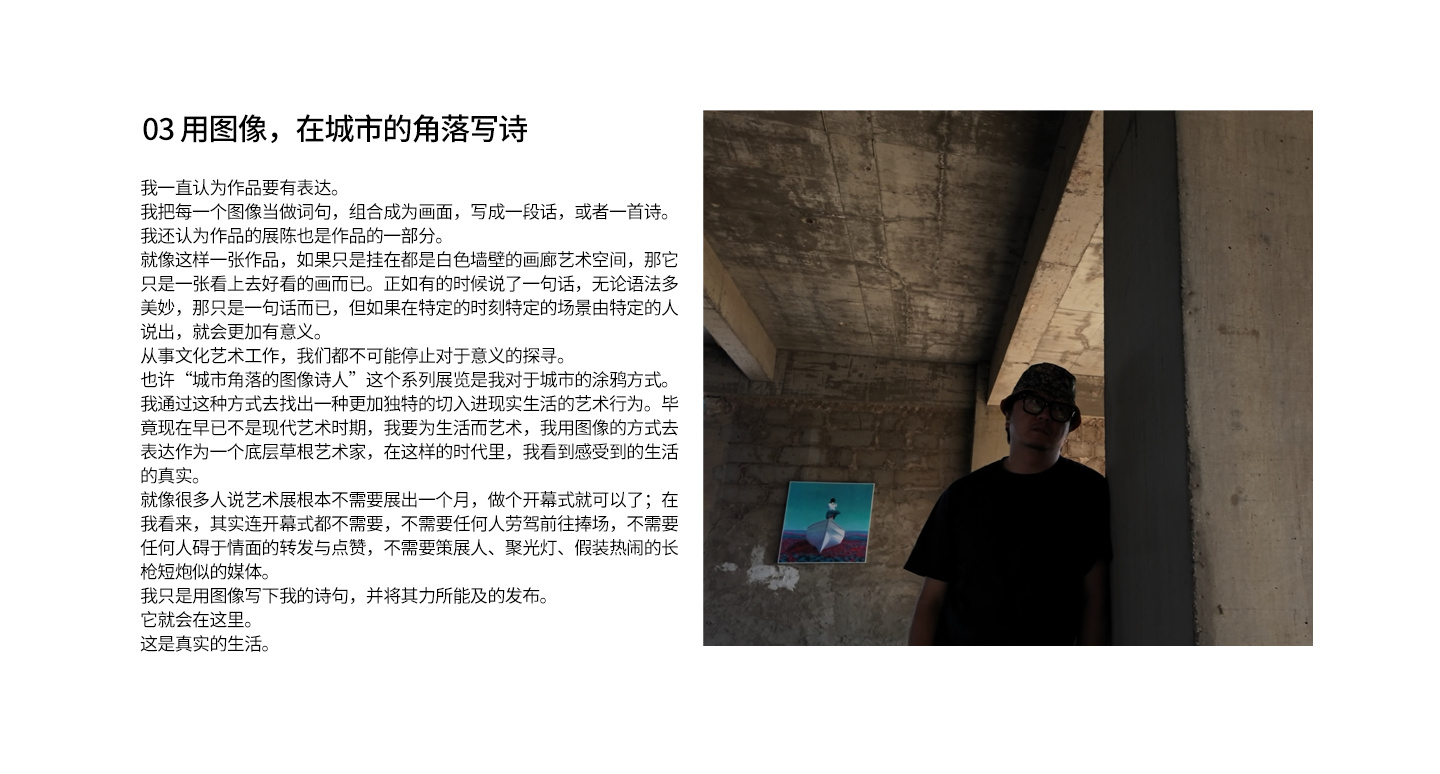
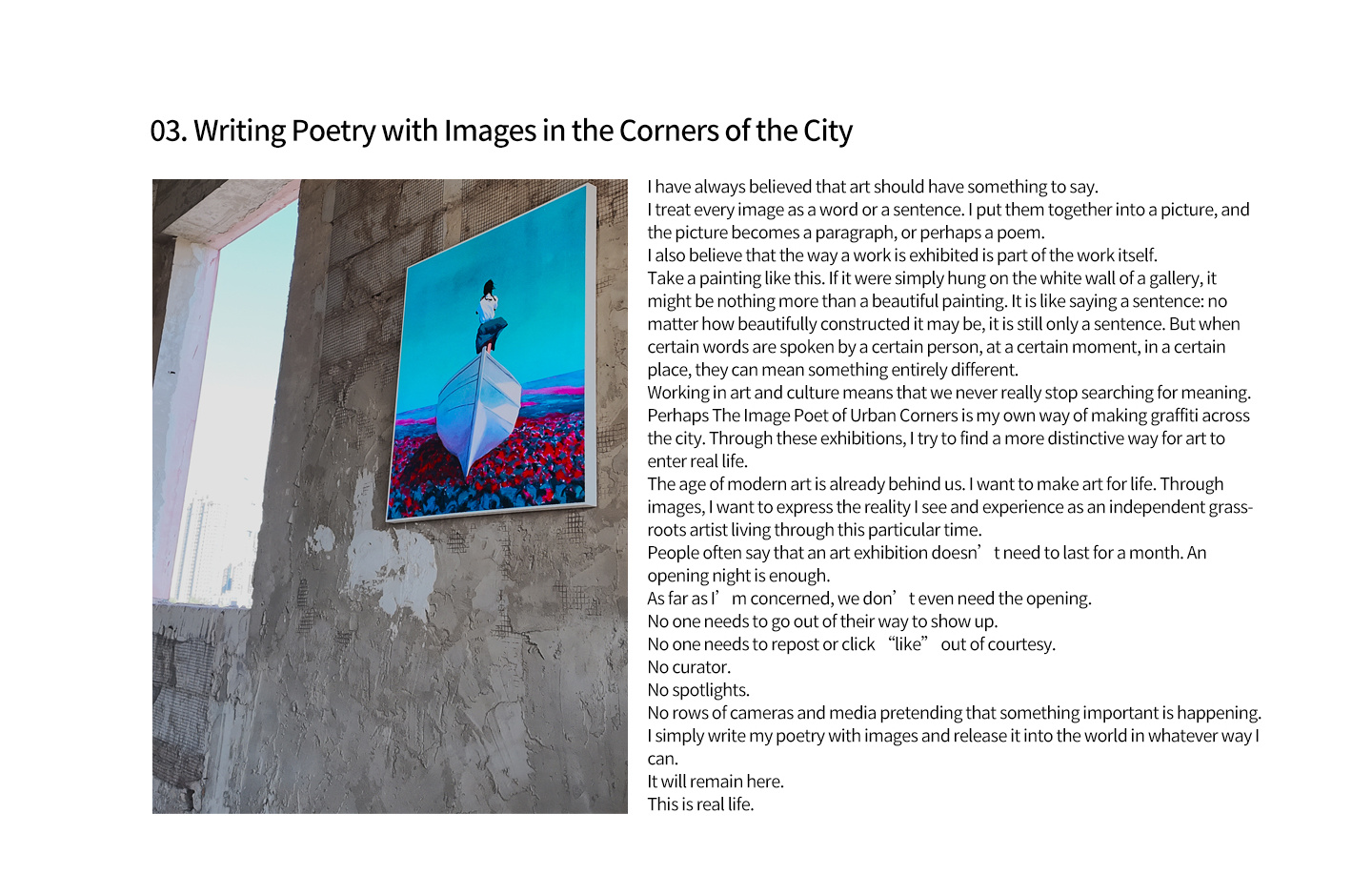
我搬了几张画走进了这栋废楼,我把色彩明快鲜艳的画作挂在赤裸着防火砖与抹灰钢丝网的墙面上,没有射灯,没有观众,只有阳光照射着灰尘,一览无余。
这是《城市角落的图像诗人》展览第三部分。
展览地点在燕郊的废楼,距离北京不到一公里。
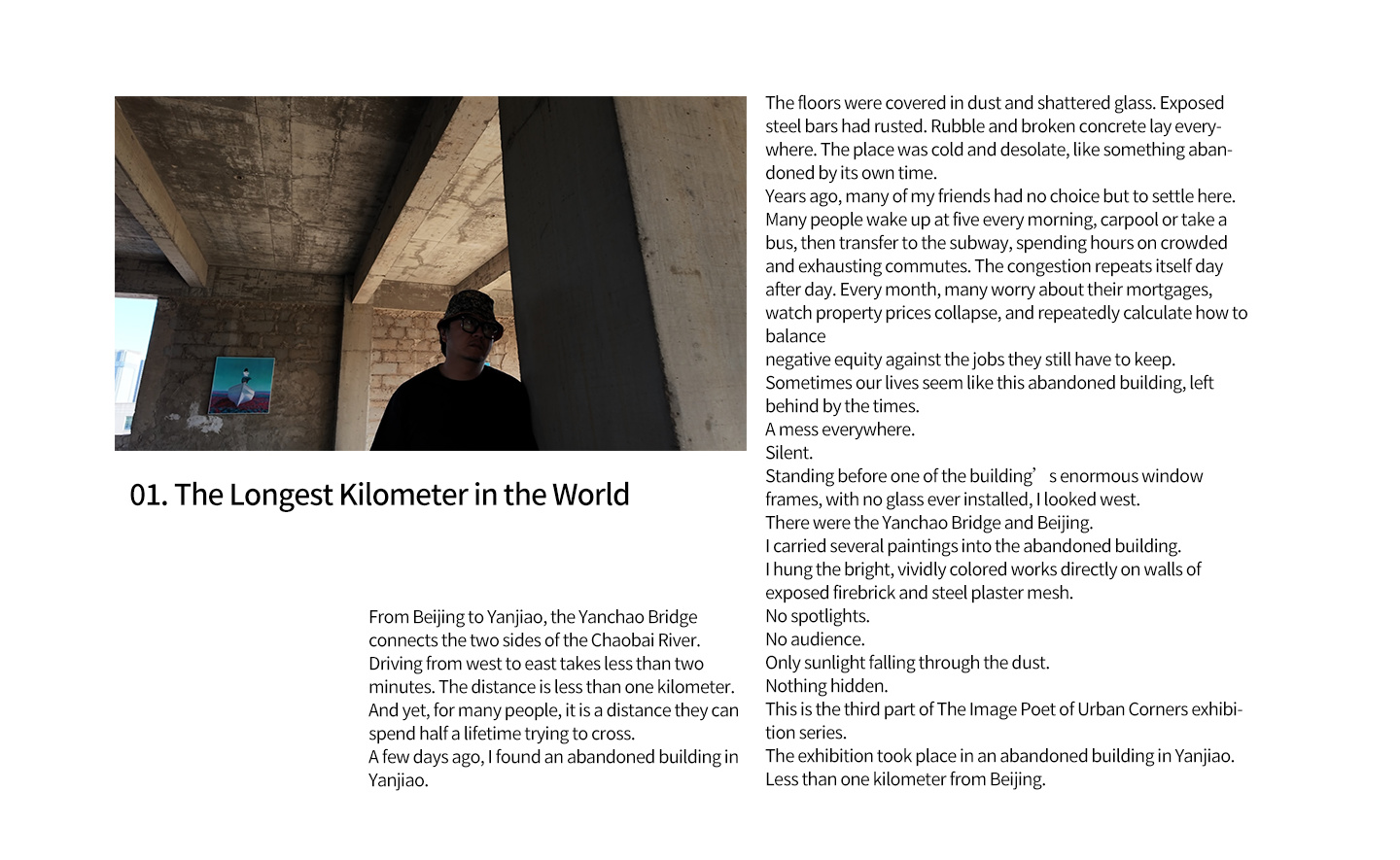
The floors were covered in dust and shattered glass. Exposed steel bars had rusted. Rubble and broken concrete lay everywhere. The place was cold and desolate, like something abandoned by its own time.
Years ago, many of my friends had no choice but to settle here.
Many people wake up at five every morning, carpool or take a bus, then transfer to the subway, spending hours on crowded and exhausting commutes. The congestion repeats itself day after day. Every month, many worry about their mortgages, watch property prices collapse, and repeatedly calculate how to balance
negative equity against the jobs they still have to keep.
Sometimes our lives seem like this abandoned building, left behind by the times.
A mess everywhere.
Silent.
Standing before one of the building’s enormous window frames, with no glass ever installed, I looked west.
There were the Yanchao Bridge and Beijing.
I carried several paintings into the abandoned building.
I hung the bright, vividly colored works directly on walls of exposed firebrick and steel plaster mesh.
No spotlights.
No audience.
Only sunlight falling through the dust.
Nothing hidden.
This is the third part of The Image Poet of Urban Corners exhibition series.
The exhibition took place in an abandoned building in Yanjiao.
Less than one kilometer from Beijing.
01. The Longest Kilometer in the World
From Beijing to Yanjiao, the Yanchao Bridge connects the two sides of the Chaobai River.
Driving from west to east takes less than two minutes. The distance is less than one kilometer.
And yet, for many people, it is a distance they can spend half a lifetime trying to cross.
A few days ago, I found an abandoned building in Yanjiao.
02 青春吹动着,高饱和的梦境
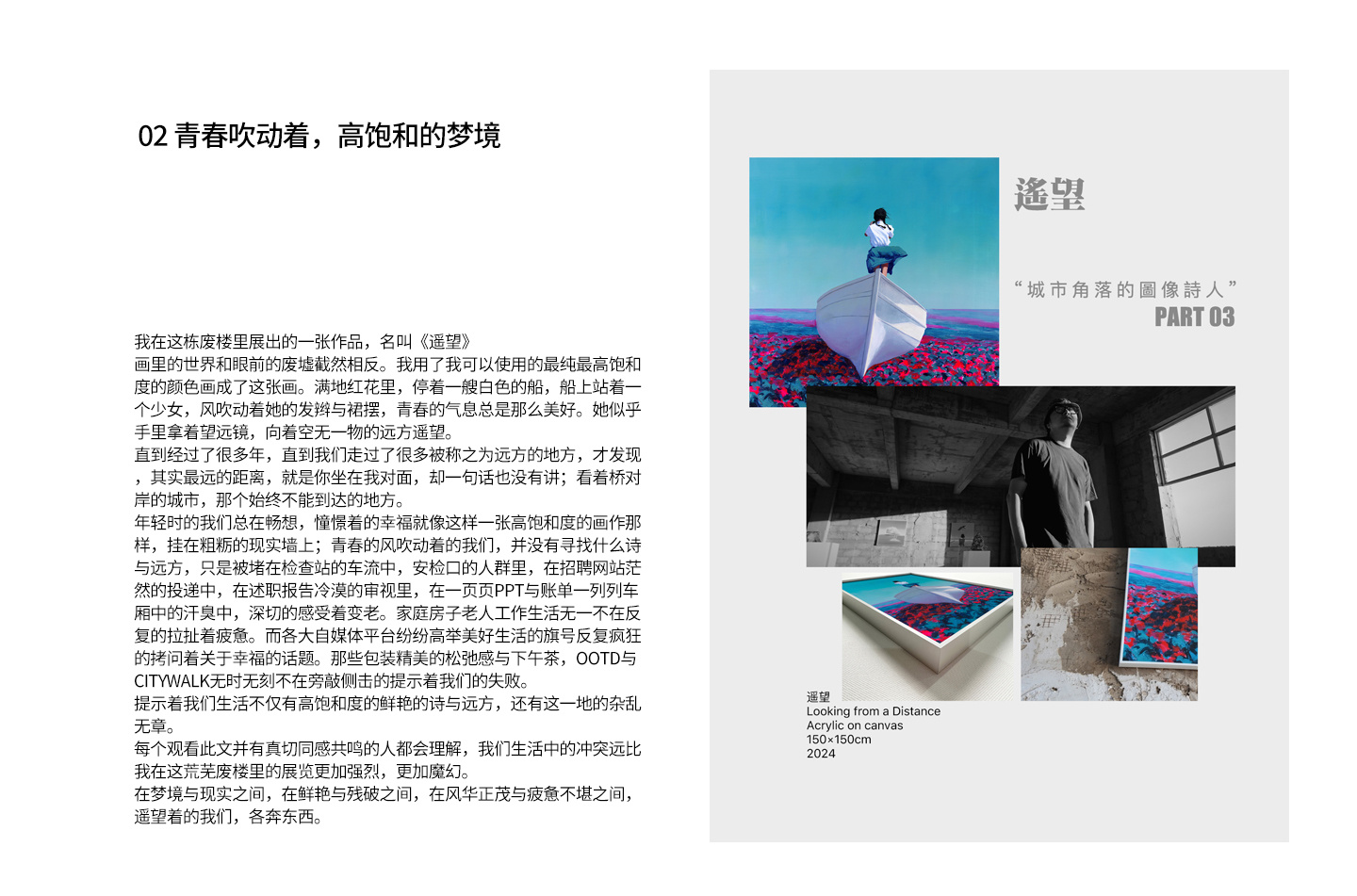
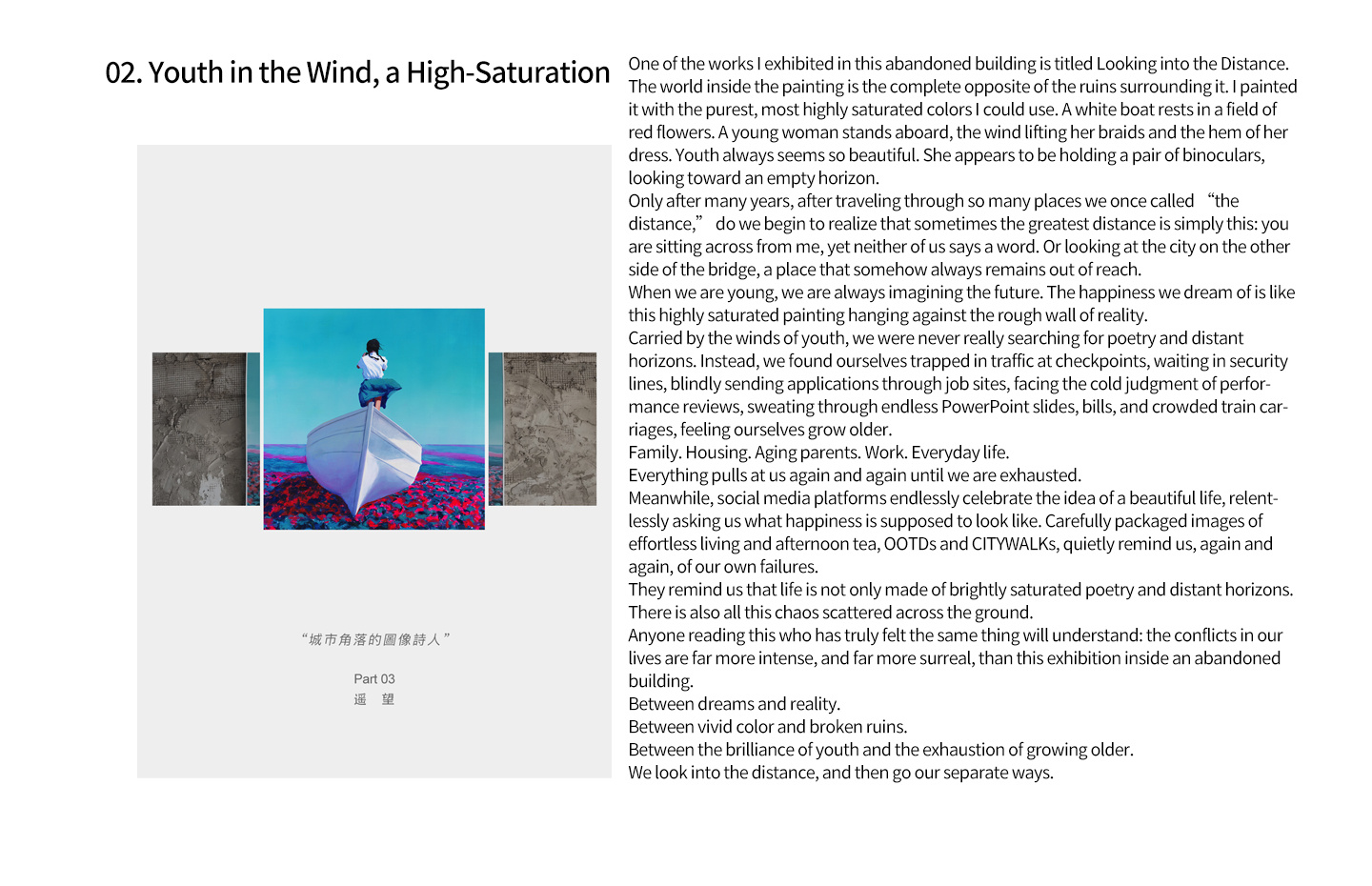
我在这栋废楼里展出的一张作品,名叫《遥望》
画里的世界和眼前的废墟截然相反。我用了我可以使用的最纯最高饱和度的颜色画成了这张画。满地红花里,停着一艘白色的船,船上站着一个少女,风吹动着她的发辫与裙摆,青春的气息总是那么美好。她似乎手里拿着望远镜,向着空无一物的远方遥望。
直到经过了很多年,直到我们走过了很多被称之为远方的地方,才发现,其实最远的距离,就是你坐在我对面,却一句话也没有讲;看着桥对岸的城市,那个始终不能到达的地方。
年轻时的我们总在畅想,憧憬着的幸福就像这样一张高饱和度的画作那样,挂在粗粝的现实墙上;青春的风吹动着的我们,并没有寻找什么诗与远方,只是被堵在检查站的车流中,安检口的人群里,在招聘网站茫然的投递中,在述职报告冷漠的审视里,在一页页PPT与账单一列列车厢中的汗臭中,深切的感受着变老。家庭房子老人工作生活无一不在反复的拉扯着疲惫。而各大自媒体平台纷纷高举美好生活的旗号反复疯狂的拷问着关于幸福的话题。那些包装精美的松弛感与下午茶,OOTD与CITYWALK无时无刻不在旁敲侧击的提示着我们的失败。
提示着我们生活不仅有高饱和度的鲜艳的诗与远方,还有这一地的杂乱无章。
每个观看此文并有真切同感共鸣的人都会理解,我们生活中的冲突远比我在这荒芜废楼里的展览更加强烈,更加魔幻。
在梦境与现实之间,在鲜艳与残破之间,在风华正茂与疲惫不堪之间,遥望着的我们,各奔东西。
One of the works I exhibited in this abandoned building is titled Looking into the Distance.
The world inside the painting is the complete opposite of the ruins surrounding it. I painted it with the purest, most highly saturated colors I could use. A white boat rests in a field of red flowers. A young woman stands aboard, the wind lifting her braids and the hem of her dress. Youth always seems so beautiful. She appears to be holding a pair of binoculars, looking toward an empty horizon.
Only after many years, after traveling through so many places we once called “the distance,” do we begin to realize that sometimes the greatest distance is simply this: you are sitting across from me, yet neither of us says a word. Or looking at the city on the other side of the bridge, a place that somehow always remains out of reach.
When we are young, we are always imagining the future. The happiness we dream of is like this highly saturated painting hanging against the rough wall of reality.
Carried by the winds of youth, we were never really searching for poetry and distant horizons. Instead, we found ourselves trapped in traffic at checkpoints, waiting in security lines, blindly sending applications through job sites, facing the cold judgment of performance reviews, sweating through endless PowerPoint slides, bills, and crowded train carriages, feeling ourselves grow older.
Family. Housing. Aging parents. Work. Everyday life.
Everything pulls at us again and again until we are exhausted.
Meanwhile, social media platforms endlessly celebrate the idea of a beautiful life, relentlessly asking us what happiness is supposed to look like. Carefully packaged images of effortless living and afternoon tea, OOTDs and CITYWALKs, quietly remind us, again and again, of our own failures.
They remind us that life is not only made of brightly saturated poetry and distant horizons.
There is also all this chaos scattered across the ground.
Anyone reading this who has truly felt the same thing will understand: the conflicts in our lives are far more intense, and far more surreal, than this exhibition inside an abandoned building.
Between dreams and reality.
Between vivid color and broken ruins.
Between the brilliance of youth and the exhaustion of growing older.
We look into the distance, and then go our separate ways.
02. Youth in the Wind, a High-Saturation Dream
03 用图像,在城市的角落写诗
我一直认为作品要有表达。
我把每一个图像当做词句,组合成为画面,写成一段话,或者一首诗。
我还认为作品的展陈也是作品的一部分。
就像这样一张作品,如果只是挂在都是白色墙壁的画廊艺术空间,那它只是一张看上去好看的画而已。正如有的时候说了一句话,无论语法多美妙,那只是一句话而已,但如果在特定的时刻特定的场景由特定的人说出,就会更加有意义。
从事文化艺术工作,我们都不可能停止对于意义的探寻。
也许“城市角落的图像诗人”这个系列展览是我对于城市的涂鸦方式。我通过这种方式去找出一种更加独特的切入进现实生活的艺术行为。毕竟现在早已不是现代艺术时期,我要为生活而艺术,我用图像的方式去表达作为一个底层草根艺术家,在这样的时代里,我看到感受到的生活的真实。
就像很多人说艺术展根本不需要展出一个月,做个开幕式就可以了;在我看来,其实连开幕式都不需要,不需要任何人劳驾前往捧场,不需要任何人碍于情面的转发与点赞,不需要策展人、聚光灯、假装热闹的长枪短炮似的媒体。
我只是用图像写下我的诗句,并将其力所能及的发布。
它就会在这里。
这是真实的生活。
03. Writing Poetry with Images in the Corners of the City
I have always believed that art should have something to say.
I treat every image as a word or a sentence. I put them together into a picture, and the picture becomes a paragraph, or perhaps a poem.
I also believe that the way a work is exhibited is part of the work itself.
Take a painting like this. If it were simply hung on the white wall of a gallery, it might be nothing more than a beautiful painting. It is like saying a sentence: no matter how beautifully constructed it may be, it is still only a sentence. But when certain words are spoken by a certain person, at a certain moment, in a certain place, they can mean something entirely different.
Working in art and culture means that we never really stop searching for meaning.
Perhaps The Image Poet of Urban Corners is my own way of making graffiti across the city. Through these exhibitions, I try to find a more distinctive way for art to enter real life.
The age of modern art is already behind us. I want to make art for life. Through images, I want to express the reality I see and experience as an independent grassroots artist living through this particular time.
People often say that an art exhibition doesn’t need to last for a month. An opening night is enough.
As far as I’m concerned, we don’t even need the opening.
No one needs to go out of their way to show up.
No one needs to repost or click “like” out of courtesy.
No curator.
No spotlights.
No rows of cameras and media pretending that something important is happening.
I simply write my poetry with images and release it into the world in whatever way I can.
It will remain here.
This is real life.
视频位置
The Image Poet of Urban Corners Part 03
城市角落的图像诗人 第三部分
遥望 Looking from a Distance 01
视频位置
The Image Poet of Urban Corners Part 03
城市角落的图像诗人 第三部分
遥望 Looking from a Distance 02
版权所有:行星文化(苏州)有限公司 苏ICP备2021005664号-1